

Ride stronger and recover faster between training blocks
Licensed therapists · Midtown East · Open 7 days · Sessions from $169
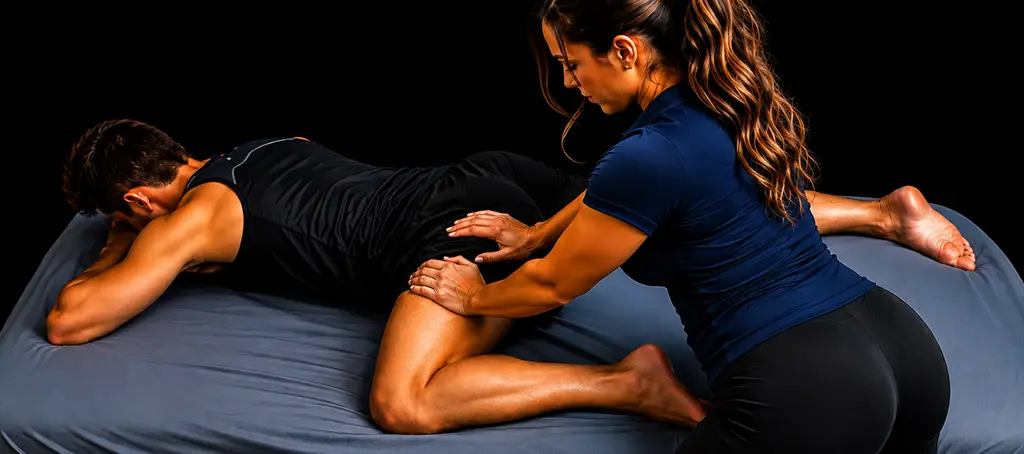
Book My SessionSports massage for cyclists is targeted soft tissue work for the quads, hip flexors, glutes, calves, neck, and lower back that absorb the load of every pedal stroke. Every session at Elite Healers Sports Massage starts with an assessment of your riding position, your training load, and where tension is building. Then we work the tissue that is limiting your ride.
This is not a spa massage. Spa massage works the surface for an hour. Sports massage works the tissue, the fascia, and the imbalance underneath the symptom, so the result holds after you get back on the bike.
Cycling Sports Massage at a Glance
- Who it is for: road cyclists, triathletes, NYC event riders, Peloton and indoor riders, and daily bike commuters.
- What we work: quads, hip flexors, glutes, the IT band region, calves, neck, shoulders, and lower back.
- How often: about once a week in season, twice a week in peak-volume weeks, and every 2 to 4 weeks in early preseason.
- Session lengths: 60, 90, or 120 minutes, with sessions from $169.
- Where: 120 East 56th Street, Suite 420, New York, NY 10022. Open 7 days.
Who Sports Massage for Cyclists Is Built For
This program is built for riders who treat training like an investment. You will get the most out of it if you are:
- A road cyclist logging consistent miles on the West Side Highway, the GW Bridge, or River Road.
- A triathlete building toward an Olympic, half-Iron, or full-Iron distance race.
- An event rider preparing for the Five Boro Bike Tour, GFNY, or a gran fondo.
- A Central Park loop regular with recurring tightness from repeated climbs and a tucked position.
- A serious indoor rider on Peloton, Zwift, or SoulCycle whose training load is producing recurring tension.
- A bike commuter with neck, shoulder, or lower back tension from daily riding.
- A cyclist working back from IT band irritation, knee pain, or a back strain alongside your physical therapist.
It is not the right fit if you want a light, general relaxation session. Our Swedish massage in NYC is built for that. If you have had a recent crash, a suspected fracture, a fever, or an acute injury, get medical clearance before you book.
Why Cyclists Need Sport-Specific Massage
Cycling locks your body into one position for hours. At a typical cadence of 85 rpm, you complete roughly 5,000 pedal strokes an hour through the same short range of motion. Your hip flexors stay shortened, your quads do most of the work, your upper back stays rounded, and your neck stays extended to watch the road.
That repetition builds strength in a narrow pattern. Over time it also builds imbalance. The quads overpower the glutes, the hip flexors pull on the lower back, and the tissue along the outer thigh loads the knee. Those patterns show up as a tight IT band, a sore lower back at hour two, or a neck that aches after every long ride.
Indoor riding compounds it. There is no coasting, no standing descent, and no change in terrain, so load accumulates faster per minute on the bike. Sport-specific massage addresses the exact tissue that cycling overloads instead of giving you a generic full-body session.

Muscles Used in Cycling and How We Work Them
- Quadriceps and Hip Flexors Your quads drive the downstroke and your hip flexors lift the leg through the top of the pedal circle. Both shorten under volume. We release the rectus femoris, vastus lateralis, iliopsoas, and tensor fasciae latae to restore hip extension and take load off the knee and lower back.
- Glutes and Hamstrings Your glutes power climbs and hip extension, and your hamstrings finish the pull through the bottom of the stroke. When the glutes underperform, the hamstrings and lower back pick up the slack. We work the posterior chain so the glutes can do their job and the hamstrings stop guarding.
- Calves and Achilles The gastrocnemius and soleus stabilize the ankle and transfer force to the pedal on every stroke. Tight calves pull on the Achilles tendon and the plantar fascia. We release the calf complex to restore ankle mobility and ease tension through the heel.
- Neck, Shoulders, and Lower Back The upper traps, levator scapulae, pecs, and lats hold you on the bars, and the erector spinae hold your torso in flexion. These are the areas most recreational riders feel first. We treat them as part of the cycling kinetic chain, not as an afterthought to the legs.
Common Cycling Injuries We Work On
Massage supports clinical care. It does not replace it. If you have a diagnosis from your physician or physical therapist, bring it, and we build your sessions around that plan.
-
IT Band Syndrome and Cyclist's Knee Pain
Lateral knee pain in cyclists often traces back to a tight tensor fasciae latae, overworked quads, and weak glute control, frequently combined with saddle height or cleat position. We work the tissue loading the IT band region and the quads above the knee, and we flag bike fit issues when your pattern points to them. -
Lower Back Pain on the Bike
Hours in lumbar flexion, plus tight hip flexors and hamstrings, strain the lower back. We release the hip flexors, glutes, and erector spinae to reduce the pull on the spine. Riders with recurring back pain can also see our back pain massage in NYC. -
Neck and Shoulder Tension From Riding Position
An aggressive position keeps the neck extended and the shoulders loaded. We work the upper traps, levator scapulae, and pecs to restore head and shoulder mobility. For persistent shoulder restriction, our shoulder massage therapy goes deeper. -
Achilles and Foot Pain
Repeated ankle loading and tight calves can irritate the Achilles tendon and the plantar fascia. We release the calf complex and the tissue of the foot. Riders with heel pain can also review our plantar fasciitis massage.

Our Cycling Sports Massage Techniques
Our cycling-focused sessions can incorporate different techniques depending on your training phase, riding volume, symptoms, and recovery goals.

Deep tissue massage. Slow, targeted pressure on the quads, glutes, and hamstrings to reduce deep restriction. Learn more about our deep tissue massage in NYC.
Myofascial release. Sustained work on the connective tissue of the outer thigh, hips, and back that standard massage misses. See our myofascial release therapy.
Trigger point therapy. Direct pressure on active knots in the glutes, calves, and upper traps that refer pain into the knee, foot, and neck.
Cupping therapy. Decompression to improve tissue glide through the quads, IT band region, and lower back. Read about our cupping therapy in NYC.
Assisted stretching. Therapist-guided stretching for the hip flexors, hamstrings, and calves to restore the range the bike takes away. Explore assisted stretching in NYC.
Pre-event and post-event massage. Short, stimulating work before an event and focused flush work in the one to two days after a long ride or race.
Red light therapy. Available on request or when your therapist determines it will support your results.
Adam Cardona LMT also applies instrument-assisted soft tissue mobilization (IASTM) within his sessions when it will improve results for chronic cycling restrictions. IASTM is available with Adam only.
How Often Cyclists Should Get a Sports Massage
Frequency follows accumulated tissue load, not the calendar. In season, most riders do well with one session a week and two during their highest-mileage weeks. Early preseason calls for a session every 2 to 4 weeks unless an imbalance shows up. Off season, general deep tissue work every few weeks keeps you ready for the next build.
When an imbalance or flare-up appears, we switch to repair mode: one or two sessions a week for a few weeks, then back to your standing cadence. In race week, book one or two sessions, and keep the last full session outside the final 72 hours before your event. Bike commuters and active professionals typically stay ahead of accumulating tension with a session every 4 weeks.
For the full framework, read our guide on how often you should get a massage.

Why Cyclists Choose Elite Healers Sports Massage
We are a clinical sports massage practice, not a spa. Every therapist on our team of licensed massage therapists is trained in the same assessment-first framework for endurance athletes. Assessment comes first in every session.
Over 200 reviews at a 4.9 star average. The practice has been featured in Forbes, Muscle and Fitness, Runner's World, Newsweek, and Peloton.
We are located at 120 East 56th Street, Suite 420, New York, NY 10022, a short ride from the Central Park loop and an easy stop for riders commuting through Midtown East. We are open 7 days, with 60, 90, and 120 minute sessions. See current rates on our massage therapy pricing page.
Want more on the performance side? Read our guide to sports massage for cycling performance, or browse all of our sports massage services in NYC.
Frequently Asked Questions About Sports Massage for Cyclists
Is sports massage good for cyclists?
Yes, for most riders. Cycling repeats the same short range of motion thousands of times an hour, so the quads, hip flexors, and calves shorten while the neck and lower back hold a fixed position for hours. Sports massage targets those specific areas to restore range of motion, reduce the restriction that builds between rides, and help you absorb training load. Most cyclists notice looser hips and a smoother pedal stroke after the first session.
How often should a cyclist get a sports massage?
Frequency follows your training load, not the calendar. In season, most riders do well with one session a week and two during their highest-volume weeks. Early preseason typically calls for a session every 2 to 4 weeks, and off season every few weeks. If an imbalance or flare-up shows up, we shift to one or two sessions a week for a few weeks, then return to your standing cadence. Our guide on how often you should get a massage breaks down every scenario.
Should I get a massage before or after a big ride or race?
Both have a role. A full sports massage session lands best one to two days after a long ride or event, focused on the muscles you just loaded. Before an event like the Five Boro Bike Tour or GFNY, book your last full session at least 72 hours out so your legs feel fresh on race day. Short pre-event work is light and stimulating, not deep, and never replaces your warm-up.
Can sports massage help IT band pain from cycling?
Massage can ease the tension that often drives lateral knee pain in cyclists. We work the tensor fasciae latae, glutes, quads, and the tissue along the outer thigh that load the IT band region, and we look at how your hip and knee track. It supports care from your physician or physical therapist and does not replace it. If knee pain is sharp, swollen, or getting worse, get it evaluated first.
Why do my neck, shoulders, and lower back hurt after riding?
The riding position holds your neck extended to see the road, your shoulders braced on the bars, and your lower back flexed for hours. Tight hip flexors add load to the lumbar spine. Sports massage for cyclists works the upper traps, levator scapulae, pecs, lats, and hip flexors that hold that position, and many riders find it relieves the ache that shows up in the second hour of a ride. Bike fit matters too, so we flag it when your symptoms point that way.
Is sports massage useful for Peloton and indoor cyclists?
Yes. Indoor sessions keep you in one position with no coasting, no standing descents, and no terrain changes, so load builds fast in the quads, hip flexors, and lower back. Riders who do several Peloton, Zwift, or SoulCycle sessions a week often carry the same tightness as road cyclists logging far more miles.
Which session length should a cyclist book?
A 60 minute session covers one or two focus areas, like legs and hips after a long ride. A 90 minute session is the most common choice for cyclists because it covers the legs and hips plus the neck, shoulders, and back that hold the riding position. A 120 minute session suits heavy training blocks, triathletes, and riders working through more than one issue at once.
Will I be sore after a cycling sports massage, and can I ride the next day?
Some soreness for 24 to 48 hours is normal after focused work, similar to a hard training day. Hydrate, keep moving with an easy spin or a walk, and hold off on intervals or a hard group ride until your legs feel normal. We help you schedule sessions around your key workouts so recovery work never costs you a quality ride.
Can I get a sports massage after a bike crash?
Get evaluated by a physician first to rule out a fracture, concussion, or other injury. Once you are medically cleared, massage can support recovery of the bruised and guarded muscles around the injury. Bring any notes from your doctor or physical therapist to your first session so your therapist can work alongside that plan.
Book Your Sports Massage for Cycling in NYC
Whether you are building toward the Five Boro Bike Tour, adding base miles for triathlon season, working through an IT band flare-up, or holding consistency through a heavy block, the next session is the one that moves your training forward. Book online, or call us at +1-929-327-8126. We are at 120 East 56th Street, Suite 420, New York, NY 10022, open 7 days.
BOOK MY CYCLING SPORTS MASSAGE