
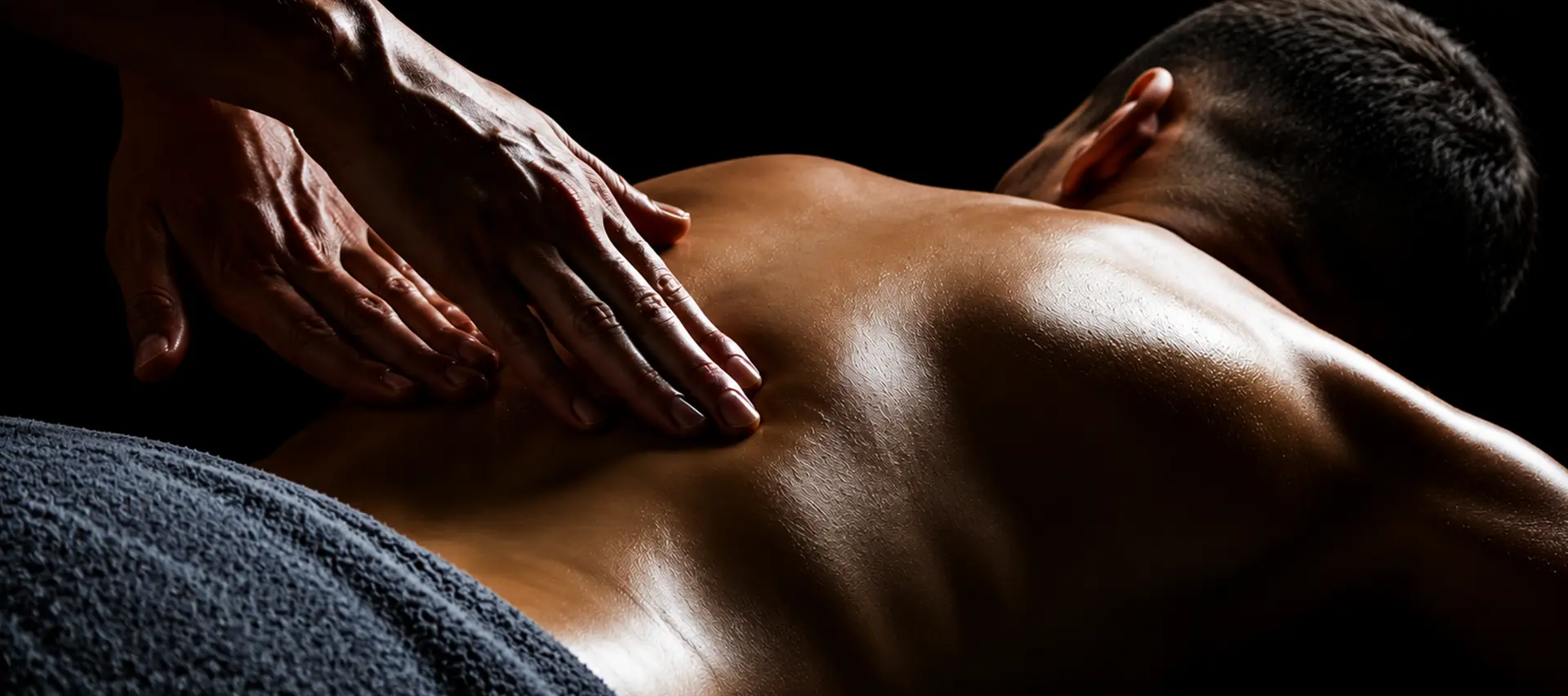
Free up the hips, thoracic rotation, and forearms your swing depends on. Sport-specific massage built for golfers.
Licensed therapists · Midtown East · Open 7 days · Sessions from $169 · FSA/HSA eligible for medical massage with a doctor's referral
The Key to Swing Mechanics, Flexibility, and Injury Prevention
Elevate your game with targeted sports massage.
Golf is a rotational sport that demands coordinated power generation across the entire kinetic chain, from the feet and glutes through the core, lats, and into the shoulder and forearm. That demand is applied repeatedly across hundreds of swings per session, which means the tissue fatigue and imbalance patterns that develop in golfers are highly predictable. Our licensed therapists at Elite Healers understand the specific muscle groups driving your swing mechanics and target them directly, reducing the tension and restriction that limits your range, consistency, and club speed over the course of a round or a season.
Whether you are a Westchester or Long Island club member playing 18 every weekend, a corporate golfer hitting 4 to 6 outings per season, a Chelsea Piers indoor practice regular, or a competitive amateur preparing for tournament play, our golf-specific massage protocol is built around the structural demands of your swing.
Sessions are available in 60-minute, 90-minute, and 2-hour formats at our Midtown Manhattan office at 120 East 56th Street, Suite 420. Same-week availability across our team. FSA and HSA accepted for medical massage with a doctor's referral.

Timing Your Sports Massage to Your Training Cycle
The timing of your massage session relative to your practice and play schedule determines what the session can accomplish. Here is how to structure your sessions across your golfing cycle:
- For beginners: As you learn the fundamentals and build strength, scheduling massages early in your training helps reduce tension and improve flexibility, setting a solid foundation for further progress.
- For intermediate golfers: During high-volume training weeks or after intense practice days, massages help alleviate muscle soreness, improve range of motion, and keep your body balanced and injury-free.
- For advanced and professional golfers: At this stage, sports massage is integral to maintaining peak performance. We recommend weekly massages during in-season play to optimize muscle condition, reduce fatigue, and enhance mobility.
When to Get a Sports Massage?
Schedule your sessions during recovery phases, after high-volume practice days, or at the end of strength training blocks. Sessions timed around your heaviest practice loads allow your therapist to address the accumulated tension before it becomes a movement restriction that shows up in your swing mechanics or escalates into an overuse injury.

The Muscles Used in Golf: Key Muscle Groups for a Powerful Swing
The golf swing is one of the most mechanically complex movements in sport. Power originates in the lower body, transfers through the core, and is delivered through the shoulder and forearm in a fraction of a second. Every structure in that chain is a potential point of restriction, and our therapists treat each one:
- Lower body power: Your glutes and quadriceps provide stability and generate force through the ground. The hamstrings and calves support rotational movements, setting up the foundation for your swing.
- Torso and core stability: The obliques, latissimus dorsi, and pectoralis major rotate the torso and transfer energy from the lower body to the upper body. Strong, flexible muscles in these areas are key to a powerful and consistent swing.
- Upper body and arm mechanics: The deltoids and rotator cuff stabilize the shoulder joint, while the biceps and triceps control the speed and direction of the club. Forearm flexors and extensors maintain a strong grip and contribute to precise control of the clubhead.
Our golfer's massage targets these crucial muscle groups, enhancing muscle coordination, reducing tension, and improving overall muscle balance to support a more effective swing.
Treating Golfer's Elbow: Medial Epicondylitis Massage in NYC
The most common overuse injury in golfers, medial epicondylitis develops when repetitive wrist flexion and gripping during the swing produces microtearing at the tendon insertion on the inner elbow, overloading the forearm flexors and pronator teres at the point of attachment.
Our protocol addresses the full forearm flexor chain using deep transverse friction, myofascial release, and graduated pressure techniques. We work proximally and distally from the pain site, because medial epicondylitis is rarely isolated to the point of pain. Most clients report significant grip strength improvement and reduction in forearm tightness within 2 to 3 sessions. For a persistent case, we coordinate with your physician or physical therapist as part of your medical massage plan.

Is Our Golfer's Massage Right For You?
Our sports massage program for golfers is built for players who treat their game as more than a casual hobby. You will get the most out of working with us if you are:
- A Westchester or Long Island club member playing weekly during the season who needs consistent recovery support.
- A competitive amateur preparing for club championships, member-guests, or USGA-qualifying events.
- A corporate golfer balancing 4 to 6 business outings per season alongside a desk-driven Midtown work schedule.
- A Chelsea Piers or other indoor practice regular working through a heavy training block.
- A golfer dealing with golfer's elbow (medial epicondylitis) that has not resolved with rest, ice, or a brace.
- A golfer with chronic lower back tightness from heavy rotation, especially common in players over 40. See our back pain massage work.
- A golfer with hip mobility restriction limiting backswing depth and follow-through.
- Recovering from a golf-related injury and needing targeted soft tissue work to complement your physical therapy.
If your goal is pure relaxation, a Swedish or therapeutic session is the better fit. If your goal is to fix what is holding back your swing and stop working around recurring pain, book a session.
Benefits of Golfer's Massage: Elevate Your Performance on the Course
Our specialized golfer's massage is designed to provide comprehensive benefits that directly enhance your performance and reduce injury risk on the course. Here is what you can expect:
Enhanced Muscle Recovery for Golfers
After a long day on the course or an intense practice session, our massage therapy accelerates muscle recovery, reducing soreness and restoring the tissue quality you need to train and play at full capacity. Faster recovery means you are ready to train harder and perform better.
Improved Range of Motion and Flexibility
A greater range of motion in the hips, shoulders, and torso leads to a more powerful and accurate swing. Our techniques target the key areas that improve flexibility and help you achieve an optimal swing plane.
Golf Injury Prevention
Repetitive movements in golf can lead to overuse injuries, especially in the shoulders, elbows, and lower back. Our golfer's massage addresses muscle imbalances and releases tension, reducing the likelihood of injury.
Increased Strength and Stability
Strength and stability in the core and lower body are essential for generating power in your swing. Our targeted work releases the chronic tension and adhesions that restrict the deep stabilizing muscles, restoring the functional stability those structures are designed to provide through every phase of your swing.
Personalizing Your Golfer's Massage at Elite Healers Sports Massage
Every golfer presents differently based on their swing mechanics, physical history, training volume, and the specific compensations their body has developed over time. Our therapists assess your presentation before every session and direct the treatment toward the structures generating the most restriction in your movement pattern. The three session types below reflect how your needs change across your golfing schedule:
- Pre-round activation: Start your day on the course with a light, invigorating massage that activates key muscle groups and prepares your body for optimal performance.
- Post-round recovery: Wind down with deep tissue work focused on reducing muscle soreness and promoting circulation, helping your body recover faster and more effectively.
- Off-season maintenance: Comprehensive sessions targeting muscle balance, strength, and flexibility keep your form sharp during the off-season, so you are always ready to hit the course in top condition.

Your swing is only as consistent as the tissue driving it. If your hips are restricted, your thoracic rotation is limited, or your forearm extensors are overloaded from grip fatigue, those restrictions will show up in your mechanics before you feel them as pain. Our therapists at Elite Healers identify those patterns and address them before they cost you distance, accuracy, or time off the course.
Sessions from $169. Open 7 days in Midtown East.
Frequently Asked Questions About Golfer's Massage in NYC
How Often Should Golfers Get a Sports Massage?
It depends on your playing volume and goals. Recreational golfers playing 1 to 2 rounds a week typically do well with a session every 3 to 4 weeks. Competitive amateurs preparing for tournament play benefit from weekly or bi-weekly sessions during peak season. Golfers managing a chronic issue like golfer's elbow or lower back tightness often need 1 to 2 sessions per week for 4 to 6 weeks before transitioning to a maintenance schedule.
Can Sports Massage Actually Improve My Golf Swing?
Yes, indirectly but measurably. Most amateur golfers have restrictions in hip rotation, thoracic mobility, shoulder external rotation, and forearm pronation that limit their swing arc, prevent full backswing depth, or compromise follow-through. Releasing those restrictions does not fix swing technique, but it removes the physical limitations that cap your swing potential. Most clients report better range of motion in their swing within 1 to 2 sessions.
What Muscles Matter Most for a Powerful Golf Swing?
Power starts in the lower body, where the glutes, quads, hamstrings, and calves generate force against the ground. It transfers through the core, obliques, and lats, then is delivered through the shoulders, rotator cuff, and forearms. A restriction anywhere along that chain, a tight hip, limited thoracic rotation, or overloaded forearm flexors, caps how much of your potential swing actually reaches the clubhead. We assess and treat the full chain rather than one isolated area.
How Is Sports Massage Different From a Regular Spa Massage for Golfers?
A spa massage is built for relaxation. Sports massage is built for performance and recovery. Our golfer's massage targets the specific muscles, fascia, and connective tissue involved in the golf swing using deep tissue work, myofascial release, and trigger point therapy. Sessions are designed around your training cycle and your specific issues, not a generic full-body routine.
Should I Get a Massage Before or After a Round of Golf?
Both work, but they serve different purposes. A pre-round massage is light and activating to prime the muscles and nervous system for the round ahead, best done the morning of or the day before. A post-round massage is deeper and restorative to flush accumulated tension and accelerate recovery, ideal within 24 to 48 hours after a tournament round or heavy practice block.
Can Sports Massage Help With Golfer's Elbow?
Yes. Medial epicondylitis, the medical name for golfer's elbow, is one of the conditions we treat most frequently. Our protocol uses deep transverse friction, myofascial release, and graduated pressure on the forearm flexor chain and pronator teres to address the muscular dysfunction driving the tendon stress. Most clients report significant grip strength improvement and reduced forearm tightness within 2 to 3 sessions. For best results, combine massage with rest from the aggravating activity and any prescribed physical therapy.
Is Golfer's Elbow the Same as Tennis Elbow?
No, though they are closely related. Both are forms of epicondylitis, an overload of the tendons that attach at the elbow. Golfer's elbow is medial epicondylitis, felt on the inner elbow and driven by the wrist flexors and pronators used to grip and flex the wrist. Tennis elbow is lateral epicondylitis, felt on the outer elbow and driven by the wrist extensors. Same family, opposite sides. Our golfer's elbow work targets the forearm flexor chain specifically.
Do You Accept FSA or HSA for Golf-Related Massage Treatment?
Yes, when the treatment is for a documented orthopedic condition. Golfer's elbow, chronic lower back pain, shoulder impingement, hip restriction, and similar musculoskeletal conditions often qualify. You will need a doctor's referral specifying medical massage and a Visa or Mastercard benefit card. Treatment for general wellness or relaxation does not qualify.
Where Is Elite Healers Sports Massage Located?
We are at 120 East 56th Street, Suite 420, in Midtown Manhattan. Convenient for golfers commuting from Westchester, Long Island, the East Side, and the Upper East Side. Open 7 days with morning, midday, and evening availability.
Ready to Stop Working Around Tightness and Pain in Your Swing?
Whether you are a Westchester club member chasing a lower handicap, a competitive amateur preparing for tournament play, a corporate golfer balancing business outings with a desk-driven schedule, or a recreational golfer dealing with chronic golfer's elbow or lower back tightness, the next session is the one that moves you forward. Same-week availability across our team. FSA and HSA accepted for medical massage with a doctor's referral.
Book your golfer's massage at 120 East 56th Street, Suite 420, Midtown Manhattan. Open 7 days. Convenient for golfers commuting from the East Side, Upper East Side, and broader Midtown area.
Reserve My Golfer's Massage SessionBooking takes under 60 seconds. Cancel or reschedule up to 24 hours in advance.
If you are not sure whether sports massage is the right next step for your specific golf situation, call us at (929) 327-8126 and we will give you an honest assessment.